
Lynnwood Directory Runs by Year
The local shelf is a network, not one unbroken Lynnwood series. The Washington State Library documents broad Snohomish County runs. Sno-Isle Libraries and genealogy catalogs identify focused Lynnwood and south-county volumes. Each title has its own area, publisher, and gaps, so cite the volume rather than treating all entries as one database.
| Collection | Years | Where held | Access |
|---|---|---|---|
| Polk's Lynnwood city directory | 1970, 1971, 1973 | Sno-Isle and SIGS cataloged holdings | Verify and use in person |
| Southwest Snohomish County | 1962 | Genealogy and regional collections | Catalog and in-library research |
| North King County–South Snohomish | 1974 | FamilySearch and regional holdings | Library or genealogy access |
| North Seattle Suburban Polk | 1980–81, 1982 | Sno-Isle, FamilySearch, local collections | In-library or catalog-directed access |
| Snohomish County directories | 1882–87; 1901–20; 1922–23; 1925–33; 1935; 1937; 1952–82; 1984; 1992–98; 2000–05 | Washington State Library list and regional repositories | Coverage varies by title and year |
| Washington telephone books | State Library collection, later dates vary | State Library and regional libraries | Appointment or local holding rules |
Those dates are holdings, not proof that every modern Lynnwood street appears. Exact pagination and complete shelf status were not published for every local volume. Ask the repository to verify the edition before making a trip.
Cataloging Lynnwood City Directories
The Washington State Library county-directory list is the best online overview for the long Snohomish County sequence. The State Library's public access changed July 1, 2025 and is now limited by appointment on Thursdays from 1 to 4 p.m. Non-digitized regional material may route through the Puget Sound Regional Branch or an Ask an Archivist request.
The captured county-directory list shows why the county run is useful even when a Lynnwood-only book is absent.
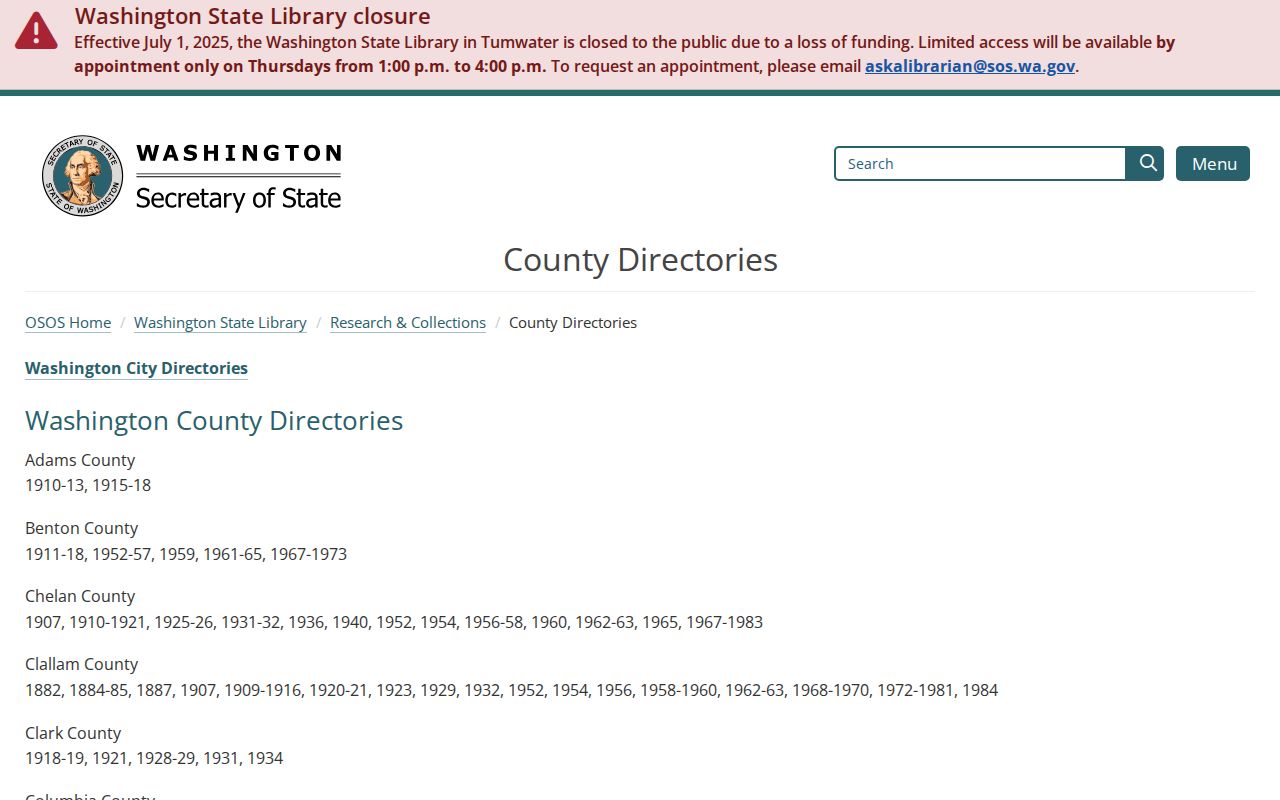
Copy the exact title, year, publisher, repository, and catalog record into your notes. Catalog geography is a finding aid, not a legal city boundary.
A second local genealogy catalog view identifies discrete Polk's Lynnwood holdings.
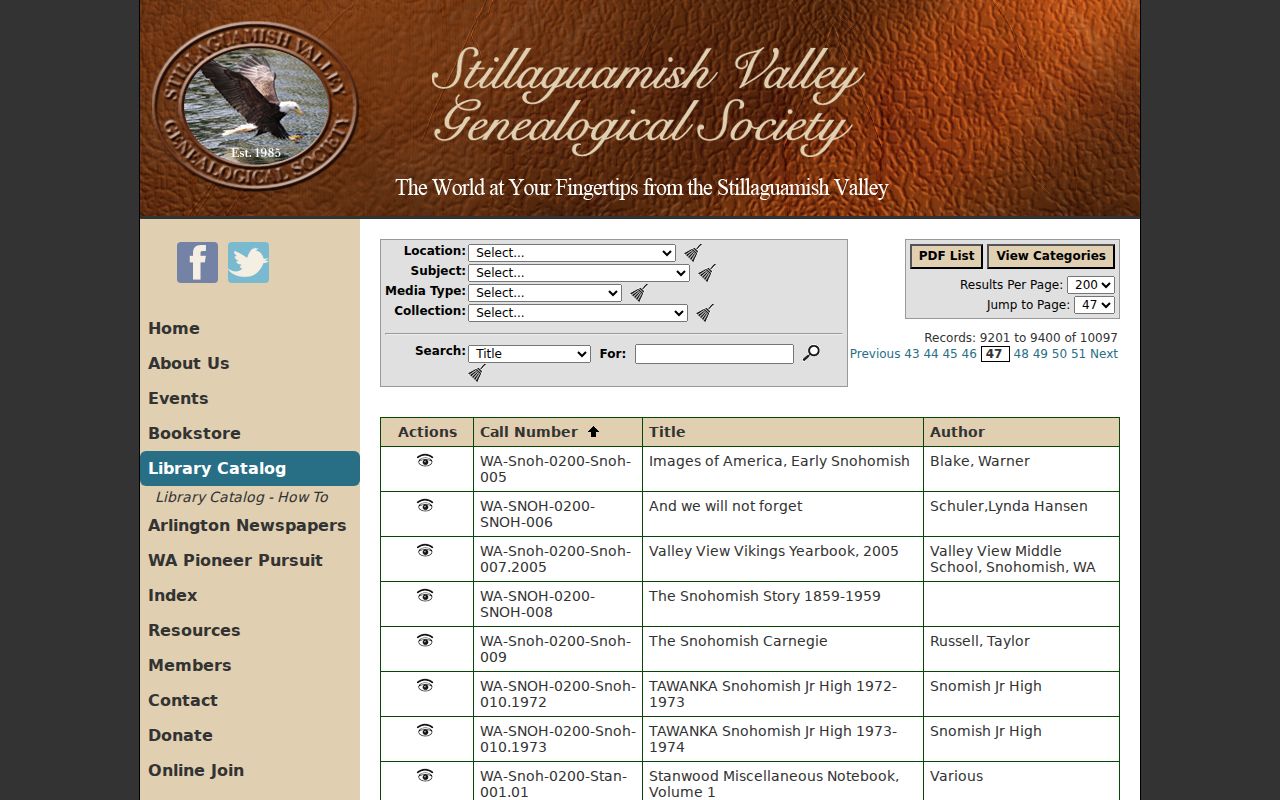
The local catalog proves the title exists, but a shelf check is still needed for page coverage and access.
Decode a Lynnwood Directory Entry
Read the front matter before interpreting a line. The local abbreviation key was not exposed online, and symbols can change by publisher or edition. Photograph or transcribe that key first. Then capture the entry exactly, including initials and punctuation, before expanding any shorthand.
| Name | Surname, given name or initials, and the printed form of any spouse or household notation. |
|---|---|
| Work | Occupation and employer when the publisher included them. |
| Address | House number, street spelling, locality, and any cross-reference as printed. |
| Household marks | Owner, occupant, widow, residence, or boarding notation only when defined by that volume's key. |
| Contact | Telephone exchange or number if the edition printed it. |
| Citation | Volume, year, page, section, title, and repository. |
Compare an alphabetical entry with the reverse street entry. A spouse or business name may explain why one side differs. Never invent a meaning for r, h, bds, wid, or employer initials without the edition's key.
- Criss-cross directory
- A section arranged by street and house number rather than by a person's surname.
- Householder index
- A publisher's address or household arrangement, which may list one named person rather than everyone present.
- Abbreviation key
- The volume's own legend for occupations, household status, streets, and other shortened terms.
Alderwood Before Lynnwood Directories
Alderwood Manor began as a planned agricultural community in 1917, decades before Lynnwood incorporated in 1959. City heritage material connects the area to the Interurban and demonstration-farm story. That history changes how a family name should be searched. An address from the first half of the century may never appear beneath the modern city label.
Try Alderwood Manor, Alderwood, South Snohomish, Edmonds, Everett suburban, and route forms alongside Lynnwood. Use a street index and the volume's coverage statement, not just the alphabetical section. A 1974 title that spans North King County and South Snohomish shows how publishers grouped communities by a regional market rather than by one city line.
The city-directory lesson is practical: a missing Lynnwood hit can be a label problem. Search the old place name before concluding that the person was absent.
Lynnwood Library Genealogy Access
Sno-Isle Libraries' genealogy resources extend the printed city directories. Ancestry Library Edition is available in a library. HeritageHub offers obituary and death-notice coverage from 1704 to today for card users. Historical photographs, NewsBank local newspapers, and microform readers can supply dates, images, and name variants. Lynnwood is one branch with a microform reader.
Lynnwood Library is at 19200 44th Ave W and can be reached at 425-778-2148. Listed hours are Monday through Thursday 9 a.m. to 8 p.m., Friday and Saturday 10 a.m. to 6 p.m., and Sunday 1 to 5 p.m. Verify hours and reader access before travel. Ask for the catalog title, call number, format, year, and database rule.
The Sno-Isle genealogy screen shown here identifies the main library databases and access limits.
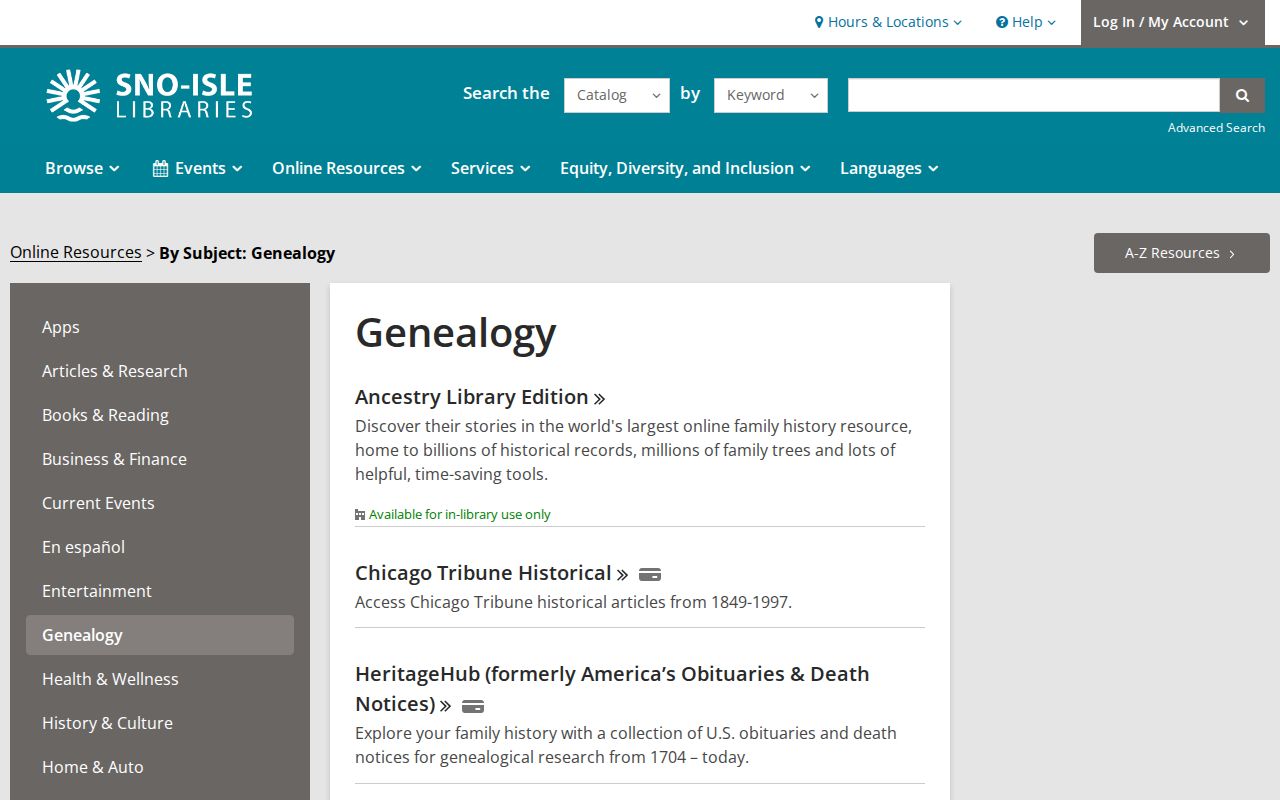
A licensed database result still needs its publication, date, page, and source recorded like a shelf item.
Lynnwood Directory Help at SIGS
The Sno-Isle Genealogical Society's Humble House is a local research stop at 19827 Poplar Way. Volunteers are available Thursday and Saturday from 11 a.m. to 3 p.m., with a second-Tuesday Genealogy Lab or appointment route. Call 425-775-6267 or email askus@snoislegenealogy.org before relying on a particular shelf volume.
Its holdings include books, maps, newspapers, original Edmonds Tribune issues, biographies, local school yearbooks, genealogy periodicals, and south Snohomish obituary clippings from 1986 through 2016. These sources can explain why a name vanished from a city directory. A yearbook may confirm school context, while a dated obituary may connect relatives and the last known place. Neither makes a current-address claim.
Note: Ask volunteers for nearby editions and regional titles when the exact Lynnwood year is missing from the catalog.
Lynnwood Heritage Adds Place Context
The Lynnwood-Alderwood Manor Heritage Association operates the Heritage Cottage and Museum at 19903 Poplar Way. Published hours are Tuesday, Thursday, and Saturday from 11 a.m. to 3 p.m. The association can add place names, planned-community history, maps, and local context to a directory find. It is not a current resident roster.
The heritage association image captured here marks the research setting next to Humble House.
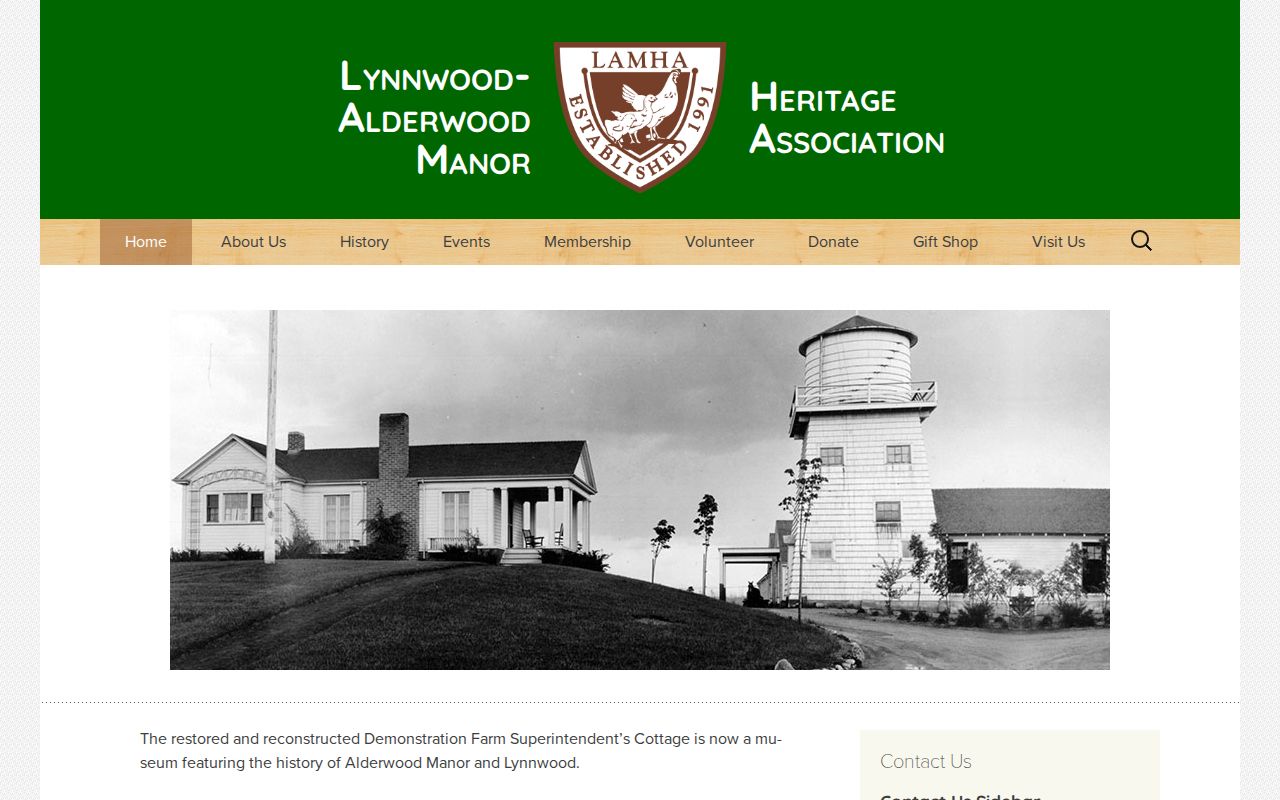
Pair an association fact with a dated public document, newspaper item, map, or directory entry before using it in a family chronology.
Lynnwood Directory Research Timeline
The publication trail makes more sense beside local and statewide record changes. These milestones help choose the next source when a volume or index has a gap.
- 1882–1887: the documented Snohomish County directory holdings begin in this period.
- 1917: Alderwood Manor's planned community began, making its name vital to early searches.
- 1959: Lynnwood incorporated, so earlier addresses may use another locality.
- 1962–1974: cataloged southwest county, Lynnwood Polk, and regional directories bridge the early city era.
- 1980–1982: North Seattle Suburban Polk editions include Lynnwood in a wider regional title.
- 1992–2005: later Snohomish County holdings continue in grouped runs rather than a promised Lynnwood annual series.
The timeline explains access but does not fill missing years. Newspapers, yearbooks, census schedules, deeds, and probate must provide independent dated evidence.
Trace Families Through Lynnwood Directories
Start with one known name, street, or year and write down the likely place label. Search both surname spellings and initials. Then move between the alphabetical and reverse sections. Consecutive editions are more useful than a wide jump because a small change in address, spouse notation, phone, or occupation can narrow an event to a short range.
- Locate the earliest likely alphabetical entry under Lynnwood and each historic locality variant.
- Check the reverse street section and record the exact address, name, symbols, volume, and page.
- Compare 1970, 1971, 1973, 1974, 1980–81, and 1982 where each title's geographic scope fits.
- Pair the directory years with public federal census schedules through 1950, keeping each source as a separate snapshot.
- Use the parcel and recorded deed for the legal land, then close a trail with a newspaper, obituary, probate file, or vital record.
A disappearance has several possible causes: a move, death, changed surname, no listing, missing edition, new street form, or coverage boundary. State Archives has a known death-index gap for 1960 through 1964, so a negative result in those years needs newspaper, probate, cemetery, county, or health-record follow-up. For a present-day name check after a historical find, use the Lynnwood resident lookup workflow and do not treat the old address as current.
Limits of Lynnwood City Directories
A city directory is an annual or periodic publisher snapshot. It may list telephone subscribers, household heads, businesses, or those who answered a canvass. Some people never appear. Rural routes and outlying areas may fall outside a title even when they later became part of Lynnwood. An official 2007 environmental review found that directories checked at Lynnwood Library did not cover one out-of-former-city site until 1996, and the site itself was not listed even then.
That local example disproves the idea that no listing means no person or place. Cite positive entries exactly and describe negative searches with the titles and years checked. Keep “listed at” separate from “owned,” “registered,” and “lived at.” Each verb belongs to a different source.
Best evidence rule. Preserve the printed entry and its date, then confirm the relevant fact through a second source with a different purpose.
A careful Lynnwood city directory search ends with a dated finding, not a claim that the printed address remained true.